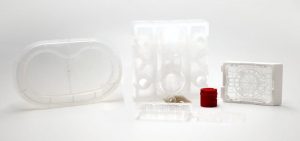
Injection molding has advanced significantly with the use of biocompatible fluoropolymers. Fluoropolymers are a type of synthetic polymer that contains fluorine atoms, providing unique properties such as high thermal stability, chemical resistance, and low friction. When these fluoropolymers are made biocompatible, they become suitable for various medical and healthcare applications.

The use of biocompatible fluoropolymers in injection molding offers several advantages:

  1. Biocompatibility: These materials are designed to be compatible with living tissues and can be safely used in medical devices and implants. This makes them ideal for applications where direct contact with the human body is necessary.
  2. Chemical Resistance: Fluoropolymers are known for their excellent chemical resistance. In medical environments, where exposure to various chemicals is possible, these materials provide a protective barrier against corrosion and degradation.
  3. High Thermal Stability: Fluoropolymers can withstand high temperatures without losing their structural integrity. This property is crucial in medical applications where sterilization processes involve elevated temperatures.
  4. Low Friction: The low coefficient of friction of fluoropolymers makes them suitable for applications where smooth surfaces and minimal friction are essential, such as in medical devices that come into contact with bodily fluids.
  5. Precision Molding: Injection molding allows for the production of complex and precise shapes. This is particularly beneficial in medical device manufacturing where intricate designs are often required for optimal performance.
  6. Cost-Effectiveness: Injection molding is a cost-effective manufacturing process, especially for high-volume production. This makes it an attractive option for producing medical components and devices on a large scale.

Applications of biocompatible fluoropolymers in injection molding include the manufacturing of components for medical devices such as catheters, connectors, seals, and implantable devices.

It’s important to note that the adoption of these materials in medical applications requires compliance with regulatory standards and guidelines to ensure the safety and efficacy of the produced devices. Manufacturers must adhere to strict quality control measures to meet the stringent requirements of the healthcare industry.

Expertise in custom plastic injection applications not only ensures the technical accuracy of the manufactured parts but also builds trust and fosters long-term partnerships between manufacturers and clients.

For more information on the top of Biocompatible Fluoropolymer Advances, please see our white paper at:

https://performanceplastics.com/blog/biocompatible-fluoropolymers/

Performance Plastics is a world-class complex injection molding company.  We work with our customers to leverage the capabilities of ultra and high-performance materials such as PEEK, Torlon®, Ultem®, PFA, FEP, PVDF, and ETFE and can achieve extreme dimension or tight tolerance injection molded parts.

For more information on Performance Plastics’ capabilities, please contact Rich Reed, Vice President of Sales & Marketing at [email protected], or visit our website at www.performanceplastics.com.

Injection molding has advanced significantly with the use of biocompatible fluoropolymers. Fluoropolymers are a type of synthetic polymer that contains fluorine atoms, providing unique properties such as high thermal stability, chemical resistance, and low friction. When these fluoropolymers are made biocompatible, they become suitable for various medical and healthcare applications.

The use of biocompatible fluoropolymers in injection molding offers several advantages:

  1. Biocompatibility: These materials are designed to be compatible with living tissues and can be safely used in medical devices and implants. This makes them ideal for applications where direct contact with the human body is necessary.
  2. Chemical Resistance: Fluoropolymers are known for their excellent chemical resistance. In medical environments, where exposure to various chemicals is possible, these materials provide a protective barrier against corrosion and degradation.
  3. High Thermal Stability: Fluoropolymers can withstand high temperatures without losing their structural integrity. This property is crucial in medical applications where sterilization processes involve elevated temperatures.
  4. Low Friction: The low coefficient of friction of fluoropolymers makes them suitable for applications where smooth surfaces and minimal friction are essential, such as in medical devices that come into contact with bodily fluids.
  5. Precision Molding: Injection molding allows for the production of complex and precise shapes. This is particularly beneficial in medical device manufacturing where intricate designs are often required for optimal performance.
  6. Cost-Effectiveness: Injection molding is a cost-effective manufacturing process, especially for high-volume production. This makes it an attractive option for producing medical components and devices on a large scale.

Applications of biocompatible fluoropolymers in injection molding include the manufacturing of components for medical devices such as catheters, connectors, seals, and implantable devices.

It’s important to note that the adoption of these materials in medical applications requires compliance with regulatory standards and guidelines to ensure the safety and efficacy of the produced devices. Manufacturers must adhere to strict quality control measures to meet the stringent requirements of the healthcare industry.

Expertise in custom plastic injection applications not only ensures the technical accuracy of the manufactured parts but also builds trust and fosters long-term partnerships between manufacturers and clients.

For more information on the top of Biocompatible Fluoropolymer Advances, please see our white paper at:

https://performanceplastics.com/blog/biocompatible-fluoropolymers/

Performance Plastics is a world-class complex injection molding company.  We work with our customers to leverage the capabilities of ultra and high-performance materials such as PEEK, Torlon®, Ultem®, PFA, FEP, PVDF, and ETFE and can achieve extreme dimension or tight tolerance injection molded parts.

For more information on Performance Plastics’ capabilities, please contact Rich Reed, Vice President of Sales & Marketing at [email protected], or visit our website at www.performanceplastics.com.


Aircraft Maintenance Professionals are always looking for better and more efficient ways to complete their tasks.  Sometimes, in an effort to complete their tasks faster, they use items that were not designed for use in removal and damage to the underlying surfaces.

While there are currently many scraper blades on the market that are designed for adhesive removal, , not all materials are created equal.  Most of the blades currently on the market are made of three materials:  ABS, Phenolic, and Torlon.


ABS

Acrylonitrile Butadiene Styrene is a very tough, very durable thermoplastic used in a wide variety of applications. ABS is a common choice among other plastic production materials because of its durability, structural stability, and good corrosion, impact, chemical, and wear resistance.

ABS plastic is made when acrylonitrile and polystyrene monomers are polymerized with butadiene rubber to create acrylonitrile butadiene styrene (ABS). This blending is typically accomplished using an emulsification process, wherein materials that would otherwise not mix are formulated into a cohesive single product (think milk, where fats, oil, and water do not separate out of solution but exist as a homogenous mixture)

Phenolic

Phenolic is a laminated plastic used in a variety of custom plastic components due to its high strength, resistance to solvents, dielectric strength, and many other features.

Phenolics are manufactured by impregnating layers of material with a phenolic resin, and then applying heat and pressure, which transforms these layers into a solid mass. The result is a thermoset that is dense, dimensionally stable, structurally strong, has low creep, and is an excellent insulator.

Torlon


Torlon® is a high-strength, high-performance, melt-processable plastic material. It’s ability to perform under severe stress combined with its resistance to elevated temperatures makes it ideal for various applications across many industries.  Torlon (PAI) is recognized as being the highest-performing plastic that is melt-processable.

Polyamide-imides (PAIs) are thermoplastic amorphous polymers prepared by the condensation of an aromatic diamine, such as methylene diamine, and an anhydride, such as trimellitic acid chloride. PAIs have good mechanical, thermal, and chemical resistance, high strength, melt processability, and high heat capacity.

So, ABS is blended thermoplastic, Phenolic is impregnated plastic, and Torlon is a heat-treated, condensed thermoset.  Condensed thermoset materials are stronger, more resilient, and exhibit consistent performance without the risk of damaging the surfaces.

EnduroSharp® Torlon® aircraft maintenance tools were specifically designed by Performance Plastics, the Airforce Research Laboratory (ARL), and the University of Dayton Research Institute at Wright Patterson Air Force Base to safely and efficiently remove adhesives, sealants, and coatings while maintaining an effective edge and not damaging the underlying substrates.

For more information on Torlon® and/or EnduroSharp Torlon® Aircraft Maintenance Tools, please contact Aileen Crass, Product Marketing Manager at [email protected], or visit our website at www.performanceplastics.com/endurosharp.